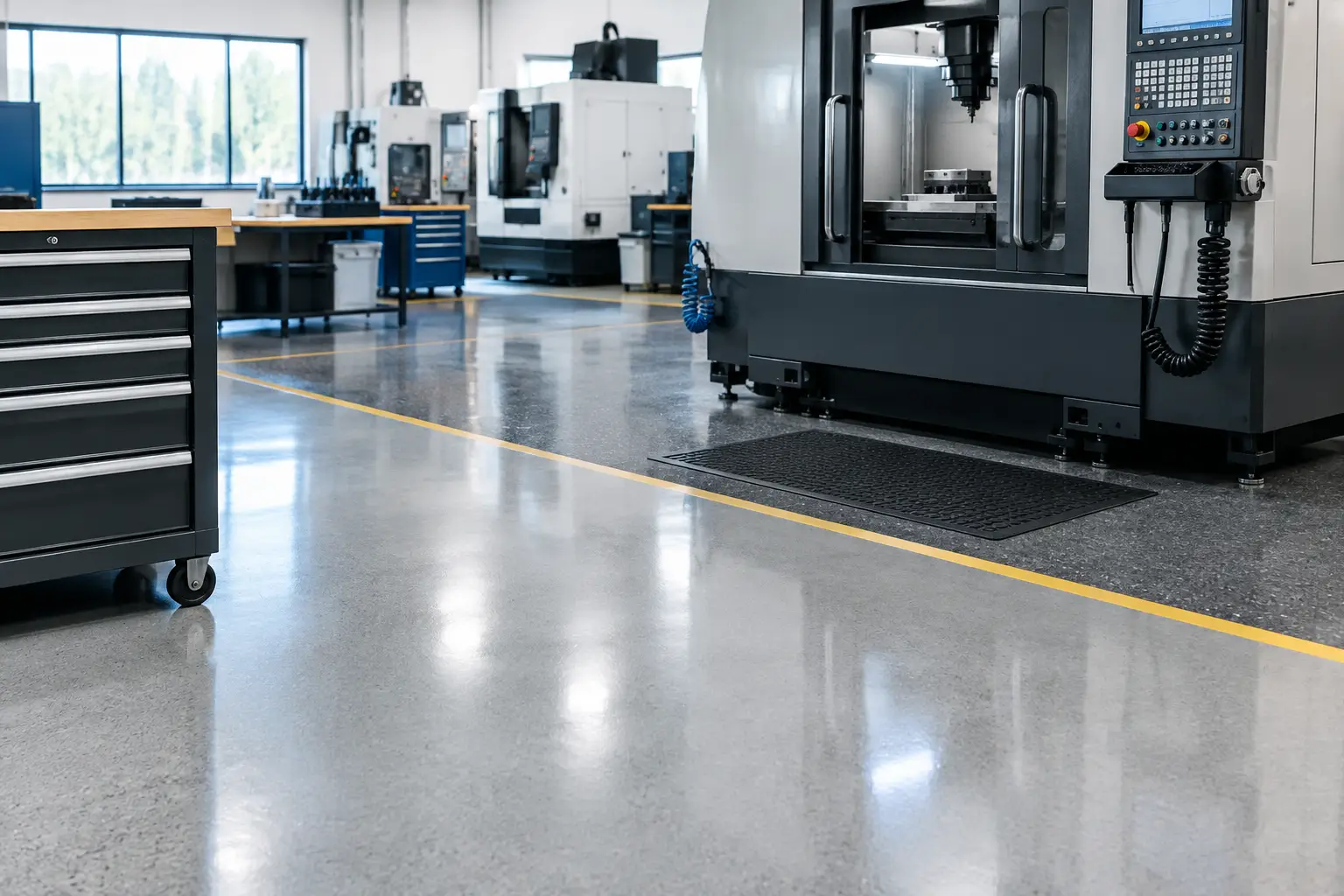

In the world of modern logistics and industrial warehousing, the floor is no longer just a surface to walk on; it is a critical piece of engineering infrastructure. As global supply chains demand higher efficiency and taller storage solutions, the requirements for industrial concrete floors have become increasingly stringent.
At Osis Group, we specialize in delivering floors that meet the world’s most demanding standards. Foremost among these is the Technical Report 34 (TR34), published by the Concrete Society. Now in its 4th Edition, TR34 is the internationally recognized benchmark for the design and construction of industrial ground floors.
Why Flatness and Levelness Matter
The terms "flatness" and "levelness" are often used interchangeably, but in the context of TR34, they describe two distinct characteristics:
- Levelness (Property E): Refers to the horizontal deviation of the floor surface over a large area. This is critical for the correct installation of racking systems.
- Flatness (Property F): Refers to the surface regularity over short distances. This is vital for the operation of Materials Handling Equipment (MHE) such as forklifts and Reach Trucks.
1. Operational Efficiency and Safety
In a Very Narrow Aisle (VNA) warehouse, forklifts operate at heights exceeding 15 meters. Even a 2mm deviation at the floor level can translate into a 50mm sway at the top of the mast. If a floor does not meet FM2 or FM1 (Superflat) classifications, it can lead to:
- Mast Sway: Increasing the risk of collisions with racking.
- Reduced Speed: Drivers must slow down to navigate bumps, reducing the number of "picks" per hour.
- Driver Fatigue: Vibrations caused by uneven floors lead to physical strain on operators.
2. Maintenance and Equipment Longevity
An uneven floor acts like a "rumble strip" for forklifts. Every bump causes impact damage to tires, bearings, and electronic components. By adhering to TR34 standards, facility managers can significantly reduce their annual MHE maintenance budgets.
Decoding TR34 4th Edition Classifications
The TR34 4th Edition provides specific categories based on the intended use of the floor. These are divided into Defined Movement (DM) and Free Movement (FM).
Free Movement (FM)
FM areas are those where vehicles travel in any direction, such as wide-aisle warehousing, manufacturing plants, and marshalling areas.
- FM1: Recommended for very high-reach applications (over 13m) and where high speed is critical.
- FM2: The standard for most high-quality warehouses with racking heights between 8m and 13m.
- FM3: Suitable for low-level racking (under 8m) or general industrial use.
Defined Movement (DM)
DM areas are specific to VNA warehouses where trucks follow a fixed path. TR34 uses "Property F" to measure the transverse and longitudinal tilt of the floor exactly where the truck wheels will travel.
- DM1 (Superflat): The gold standard for VNA aisles where racking exceeds 13m.
- DM2: Suitable for racking between 8m and 13m.
Laser Screed Technology: The Osis Group Advantage
Achieving these tolerances requires more than just pouring concrete; it requires precision engineering. Osis Group utilizes state-of-the-art Laser Screed technology to ensure high-output flooring projects meet TR34 FM2 standards with consistency.
The Laser Screed system uses a rotating laser level and an onboard computer to adjust the screed head 10 times per second. This eliminates the human error associated with manual leveling and allows for larger, "jointless" floor pours (up to 2,000m² in a single day), which further improves floor performance by reducing the number of vulnerable construction joints.
The Role of Fiber-Reinforced Concrete (FRC)
While flatness is about the surface, durability is about the structure. TR34 4th Edition provides extensive guidance on the use of Steel Fiber Reinforced Concrete (SFRC) and Macro-Synthetic Fibers.
At Osis Group, we often recommend SFRC to provide three-dimensional reinforcement. This helps in:
- Controlling Shrinkage: Reducing the width of cracks.
- Enhancing Load Capacity: Allowing the floor to support heavier racking loads and dynamic MHE traffic.
- Joint Stability: Working in tandem with armored joints to prevent "spalling" (edge breakdown) where the most damage typically occurs.
Measurement and Compliance
Measurement for compliance with TR34 must occur within 24 hours of the completion of a floor section. Using specialized digital "Profileographs" or "F-Min" meters, we can provide clients with a detailed map of their floor’s topography.
If a floor fails to meet the required DM1 or DM2 specification in a VNA aisle, Osis Group offers Laser Grinding services. This process uses computer-controlled robotic grinding to shave off high spots, bringing the floor into perfect compliance without compromising the structural integrity of the slab.
Conclusion
A high-performance floor is the foundation of a high-performance business. Whether you are building an airport hangar in Qatar, a logistics hub in the UAE, or a manufacturing plant in the KSA, understanding TR34 4th Edition is essential for long-term operational success.
Osis Group remains at the forefront of industrial flooring, combining technical expertise in TR34/ACI 360 standards with the latest construction technology to deliver "Superflat" results.
Looking to upgrade your warehouse floor? Contact Osis Group today to discuss your next project's flatness requirements and how we can help you achieve FM1 or FM2 excellence.