As the demand for fast-moving consumer goods (FMCG) continues to surge across Southern Europe, infrastructure must evolve to keep pace. For Intertrade Hellas, a leader in paper products manufacturing, the expansion of their Athens-based operations represented a pivotal step in their regional growth strategy. To support this growth, a new 14,080 m² production and distribution facility was commissioned—a project that required far more than just "pouring concrete."
At Osis Group, we were tasked with delivering a high-performance industrial floor that serves as the foundation for the facility's high-efficiency logistics. Completed in 2025, the Intertrade Hellas project stands as a benchmark for technical precision in the Greek industrial sector.
The Challenge: Navigating the Rigors of DM1 Standards
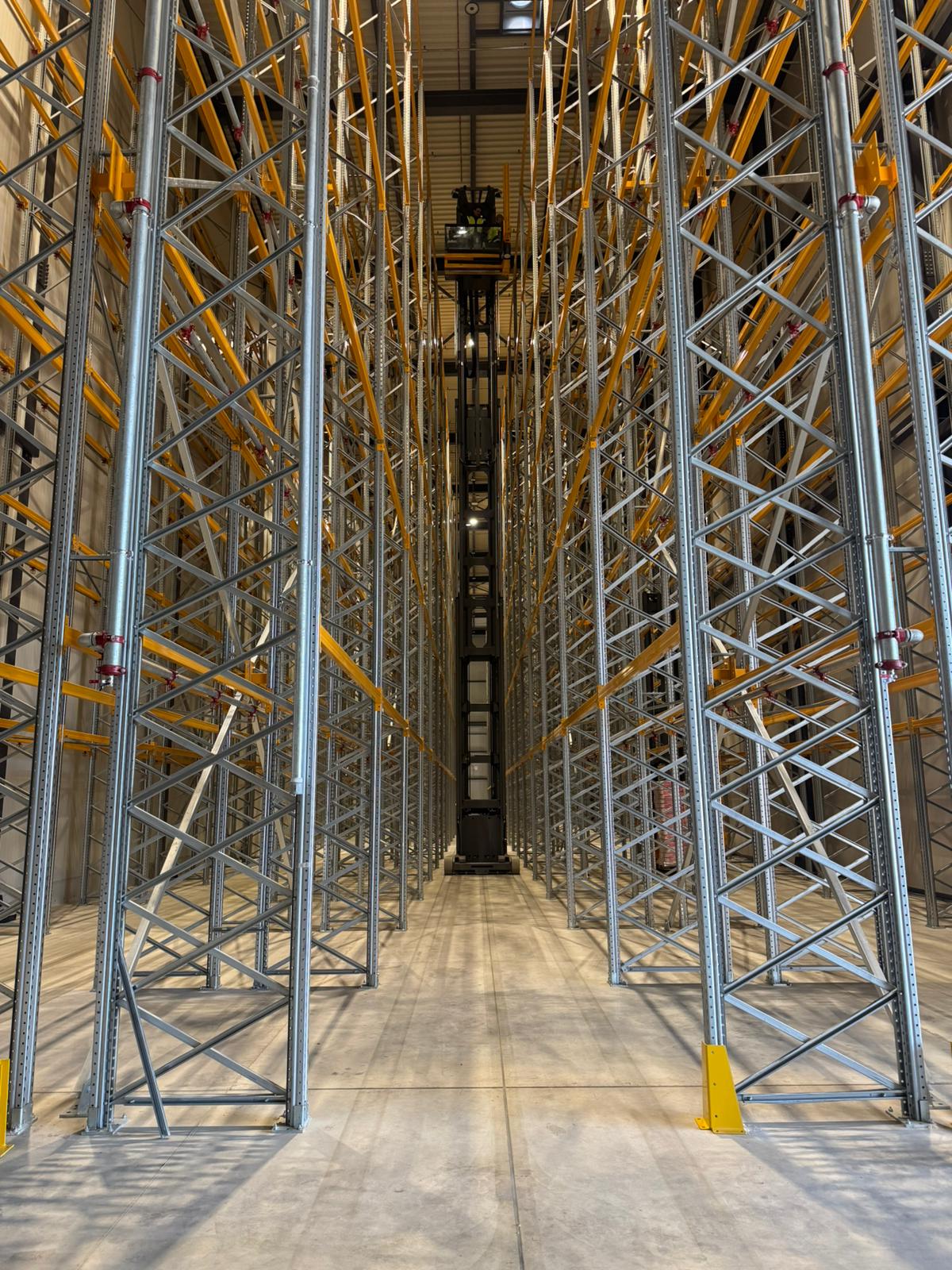
Modern warehousing is increasingly moving "upward" rather than "outward." To maximize the 14,080 m² footprint, Intertrade Hellas designed a high-density configuration utilizing Very Narrow Aisle (VNA) trucks. These automated and semi-automated machines operate with millimetric clearances between the racking systems, lifting heavy pallets to significant heights.
In such an environment, the floor is no longer a passive surface; it is a critical component of the machinery's drivetrain. The technical specification required was DM1 (Defined Movement) according to the Concrete Society’s TR34 (4th Edition).
Achieving DM1 is one of the highest hurdles in industrial flooring. Small deviations—imperceptible to the human eye—are magnified exponentially at the top of a VNA mast. A 3mm deviation at floor level could result in a 50mm sway at a 15-meter lift height, risking collisions with racking, increased wear on equipment, and severe safety hazards.
The Approach: Engineering for Stability and Longevity
To meet these exacting standards, Osis Group deployed a strategic combination of advanced material science and automated placement technology.
1. Advanced Steel Fiber Reinforcement (SFRC)
To handle the immense static loads from high-density racking and the dynamic loads of constant VNA traffic, we utilized a high-performance Steel Fiber Reinforced Concrete (SFRC) mix. By eliminating traditional rebar mesh in favor of specialized steel fibers, we created a ductile, high-strength matrix that offers superior crack control and impact resistance. This approach also allowed for a more efficient pouring schedule, reducing the overall project timeline.
2. Precision Laser Screed Technology
Achieving the general levelness of 14,080 m² required the use of Somero Laser Screed® technology. This equipment uses a 360-degree rotating laser to maintain a constant grade, ensuring the base slab meets the broad-scale leveling requirements before the specialized VNA aisles are refined.
3. VNA Aisle Specialization
While the open areas were handled with laser precision, the VNA aisles required a "Long-Strip" construction methodology. This involves pouring the concrete in narrow lanes specifically designed to match the truck wheel paths. Our team utilized specialized vibrating strike-offs and hand-finishing techniques to ensure the transverse and longitudinal gradients remained within the tight DM1 envelopes.
4. Optimized Joint Design
In a facility of this scale, joints are often the point of failure. We implemented armored expansion joints to protect the edges of the concrete slabs from the heavy impact of hard-wheeled forklifts. Furthermore, we optimized the joint layout to minimize the number of "crossings" in high-traffic zones, ensuring a smoother ride for the automated equipment and lower long-term maintenance costs for the client.
Results: A Vertical Success
The Intertrade Hellas facility was delivered on schedule in 2025, meeting and exceeding the TR34 DM1 specifications.
Key Project Specifications:
- Total Area: 14,080 m²
- Flatness Classification: TR34 DM1 (Defined Movement)
- Reinforcement: Steel Fiber Reinforced Concrete (SFRC)
- Location: Athens, Greece
- Operational Readiness: Full VNA compatibility with zero vibration or sway issues
By achieving the DM1 standard, Osis Group has provided Intertrade Hellas with a floor that allows their material handling equipment to operate at maximum rated speeds. This translates directly to higher throughput, lower energy consumption for the VNA trucks, and a safer working environment for the facility staff.
Conclusion
The Intertrade Hellas project represents the intersection of structural engineering and logistical efficiency. In the world of modern manufacturing, the floor is the foundation of the entire supply chain. At Osis Group, we are proud to have delivered a surface that doesn't just support Intertrade Hellas’ products, but accelerates their business growth.
As Athens continues to establish itself as a logistics linchpin for the Mediterranean, Osis Group remains committed to delivering the high-tolerance flooring solutions required for the industry's most ambitious projects.