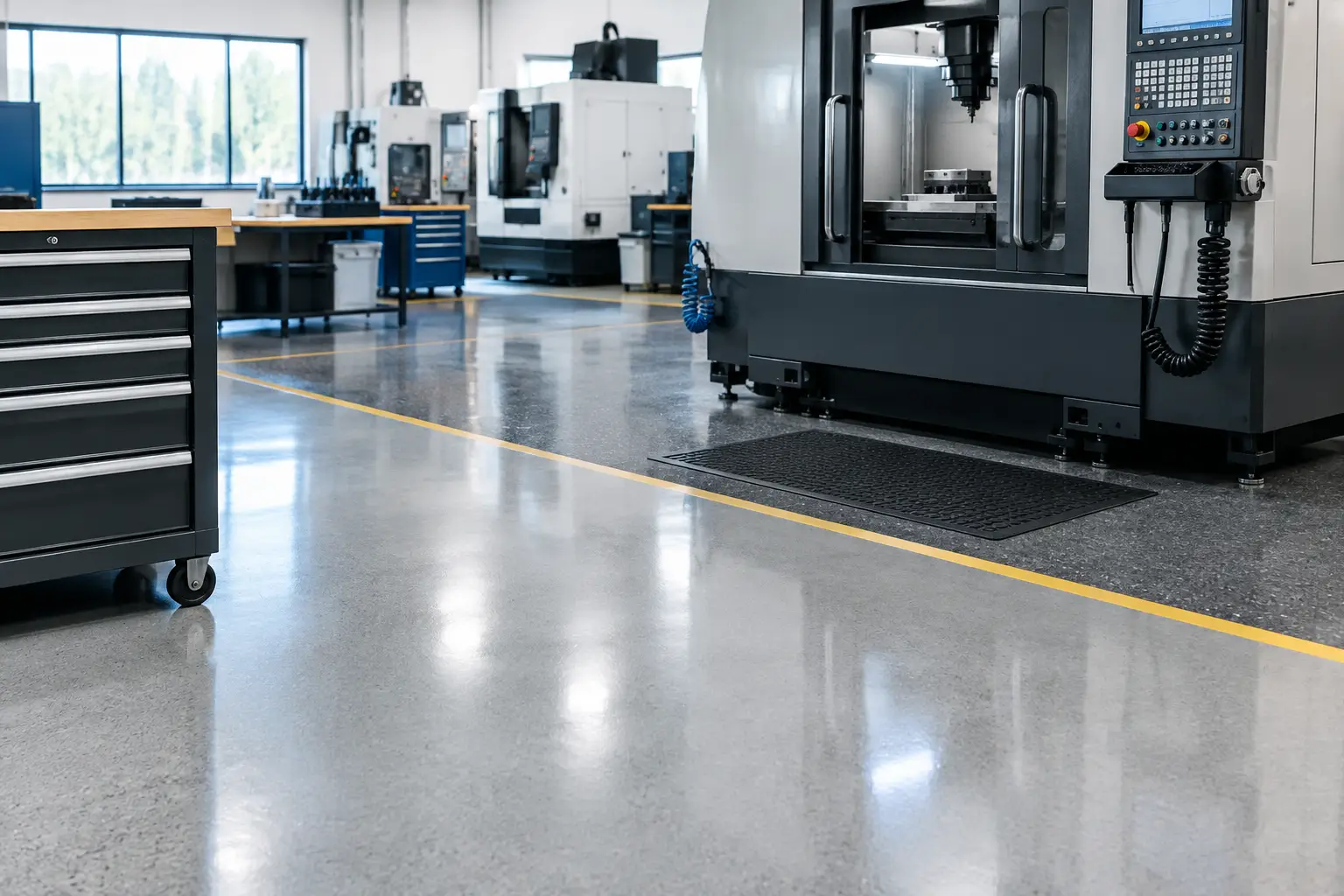
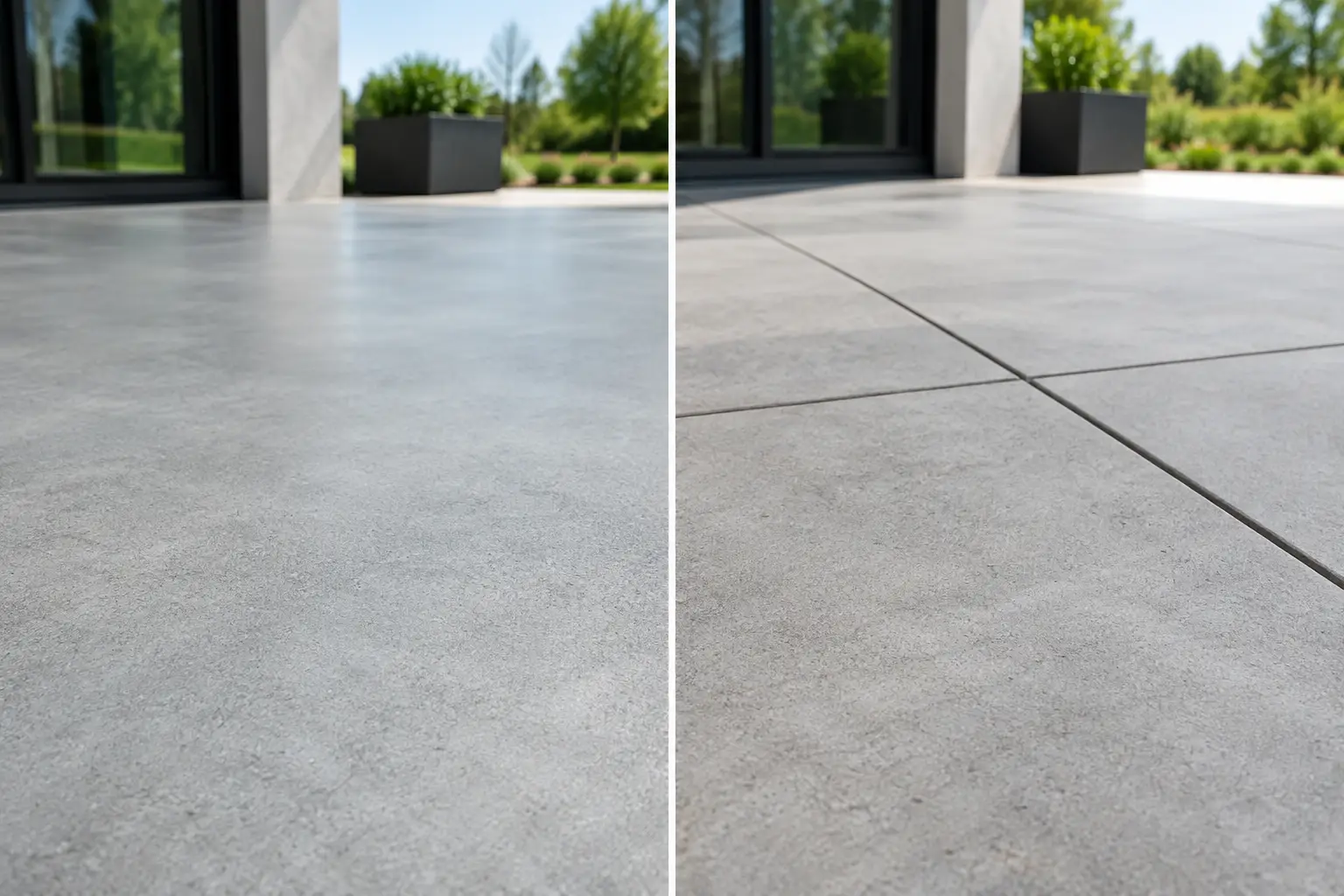
Forklift traffic does not treat every concrete joint equally. In a distribution center, manufacturing plant, or high-bay warehouse, each joint can become a point of impact, wear, noise, and maintenance. The choice between jointless slabs versus sawcut joints directly affects floor performance long after the concrete placement crew has left the site.
Neither approach is automatically right. The best decision depends on slab geometry, loading, traffic patterns, subgrade conditions, flatness requirements, construction sequencing, and the facility’s tolerance for future repair work. A floor specification should address those realities before placement, not after joint damage begins to interrupt operations.
What Sawcut Joints Are Designed to Do
Sawcut joints are contraction joints cut into freshly placed concrete. Their purpose is controlled cracking. Concrete shrinks as it cures, and a sawcut creates a weakened plane intended to guide that shrinkage crack below the surface rather than allowing random cracks across the slab.
For many commercial and industrial slabs, this is a practical and proven method. Joint spacing is typically established based on slab thickness, mix design, reinforcement, restraint, and placement conditions. When the layout and timing are correct, sawcut joints manage shrinkage in predictable locations.
The key word is manage. A sawcut joint does not eliminate movement, and it does not remain maintenance-free in every operating environment. Under repeated hard-wheel forklift traffic, loaded pallet jacks, or lift trucks crossing joints at high frequency, joint edges can deteriorate. Spalling, arris damage, filler failure, and differential elevation may follow.
In facilities with conventional traffic, moderate loading, and realistic maintenance planning, sawcut joints can be an efficient solution. They are familiar to contractors, straightforward to lay out, and often appropriate for broad areas where equipment does not repeatedly travel along fixed routes.
Where Sawcut Joints Create Operational Exposure
The problem is not that sawcut joints exist. The problem is placing them where traffic concentrates and then expecting them to perform indefinitely without protection or repair.
A forklift wheel crossing a joint transfers impact to the concrete edges. If the joint opens, the impact increases. If the joint filler is too soft, poorly bonded, installed too early, or damaged by traffic, it no longer supports the edge effectively. Over time, the result can be a repair cycle that affects ride quality, safety, equipment, and cleaning.
This exposure is especially relevant in narrow-aisle warehouses, high-throughput logistics operations, freezer facilities, and production areas with defined travel lanes. In these environments, floor joints are not a minor detail. They are part of the operating system.
What “Jointless” Actually Means
Jointless flooring is often misunderstood as a slab with no joints at all. In practice, jointless or joint-minimized slabs reduce the number of internal contraction joints through a coordinated approach to mix design, fiber reinforcement, slab design, placement strategy, and movement management.
Depending on the system, steel fibers may provide post-crack load transfer and help control crack widths. Larger placement panels, optimized joint layouts, and carefully planned construction joints can reduce the number of locations exposed to wheeled traffic. Perimeter isolation and structural movement joints still require attention. Existing building movement cannot be designed away.
The objective is not to deny that concrete moves. It is to manage shrinkage and cracking while minimizing the operational liabilities created by closely spaced sawcut joints.
For industrial facilities, fewer internal joints can mean fewer impact points, less joint filler maintenance, smoother vehicle travel, and more usable floor area for racking, automation, and material handling. Those benefits are most valuable when the floor carries frequent, repetitive traffic over the same routes.
Jointless Slabs Versus Sawcut Joints in High-Traffic Areas
The practical difference becomes clear in traffic-intensive operations. A conventional sawcut layout may place joints every 12 to 15 feet, depending on design conditions. That means a lift truck traveling the length of a warehouse crosses many joints in every shift. Each crossing is an opportunity for impact and edge wear.
A properly designed jointless slab can significantly reduce these crossings. That does not guarantee a perfect floor, nor does it remove the need for disciplined placement and curing. It does, however, reduce the number of vulnerable locations in the traffic path.
For very narrow aisle operations, flatness is equally important. VNA equipment is sensitive to elevation change, and poor slab geometry can affect mast stability, travel speed, and rack clearance. A joint-minimized design must still be placed to the required flatness and levelness standard. Fewer joints do not compensate for poor finishing, improper strike-off, or inadequate quality control.
Where defined truck paths cannot be avoided, protected construction joints or armored joints may be appropriate. These are not interchangeable with sawcut contraction joints. They serve different structural and operational functions and should be detailed accordingly.
The Trade-Off: Upfront Cost and Lifecycle Cost
Jointless systems can require more planning, specialized materials, engineering coordination, and placement expertise. Initial cost may be higher than a conventional sawcut slab. That comparison is incomplete if it stops at the concrete bid.
A facility owner should consider the cost of joint repair, traffic disruption, equipment vibration, reduced travel quality, and recurring filler replacement. In a 24-hour operation, access restrictions and shutdowns can cost more than the repair itself. The floor must be evaluated as an operating asset, not simply as a completed concrete scope.
Sawcut slabs may offer the right value where traffic is lighter, layouts are flexible, joint crossings are limited, or future modifications are likely. A jointless system may deliver stronger lifecycle value where equipment follows fixed paths, loads are heavy, uptime is critical, and repairs are difficult to schedule.
The right choice is not based on a preference for one construction method. It is based on the cost of failure in the specific facility.
Specification Decisions That Determine Performance
The slab type alone will not determine success. Several decisions require coordination among the owner, general contractor, engineer, concrete contractor, and industrial flooring specialist.
Define Traffic Before Designing the Floor
Traffic assumptions must be specific. Identify vehicle types, wheel materials, axle loads, load frequency, turning zones, dock approaches, battery charging areas, and future automation. A floor designed for occasional forklift traffic is different from a floor carrying high-frequency reach trucks with hard polyurethane wheels.
Traffic paths should be mapped early. If joint crossings cannot be eliminated, they should be positioned and protected with the operating pattern in mind. This is particularly important at aisle entrances, rack ends, transfer zones, and intersections.
Account for the Entire Slab System
Concrete is only one part of the system. Subgrade support, vapor protection, reinforcement or fiber dosage, slab thickness, curing, joint timing, and environmental conditions all influence crack control and long-term performance.
Jointless slabs require disciplined execution. Fiber distribution, placement sequencing, finishing practices, and curing must be managed to the specified standard. Excessive water addition, inconsistent consolidation, or rushed finishing can compromise the result regardless of the design intent.
Plan for Joints That Must Remain
Even a joint-minimized floor includes joints at building interfaces, placement transitions, structural separations, and other required locations. These joints need the correct geometry, protection, and filler system for the expected traffic.
Joint fillers should be selected for the slab’s stage of movement and the service conditions. A filler placed before substantial shrinkage has occurred may tear or separate as the joint opens. In high-traffic applications, repairable semi-rigid fillers are commonly used after joint movement has stabilized enough to support the joint edges effectively.
When Each Approach Makes Sense
Sawcut joints are often suitable for standard industrial areas where budgets are controlled, traffic is dispersed, and future maintenance can be managed without major operational disruption. They can perform well when joint layout, sawcut timing, curing, and filler installation are executed correctly.
Jointless slabs are often better suited to high-bay distribution, automated storage, heavy manufacturing, cold storage, and facilities with intensive hard-wheel traffic. They are also worth serious consideration where floor repairs would disrupt a tightly scheduled operation or create unacceptable safety and productivity risk.
For existing facilities, the decision may not involve a new slab at all. Joint repair, joint armoring, grinding, and floor upgrades can extend the useful life of a sawcut floor when replacement is not practical. The repair strategy should address the root cause, whether that is failed filler, broken concrete edges, differential movement, inadequate load transfer, or poor traffic routing.
A high-performing industrial floor begins with an honest assessment of how the facility will use it. Specify the slab for the wheels, loads, and uptime requirements it must support - then hold installation to the standard that operation demands.