A VNA aisle can lose productivity over imperfections measured in fractions of an inch. That is why laser guidance vs wire guidance is not simply a truck-equipment decision. It is a facility design decision that affects floor preparation, rack layout, maintenance access, commissioning, and long-term uptime.
Both systems can support safe, accurate travel in narrow warehouse aisles. The right choice depends on how fixed the operation will be, the condition of the slab, the truck manufacturer’s requirements, and the level of flexibility the facility needs after opening. The guidance technology and the floor must perform as one system.
What Laser and Wire Guidance Do
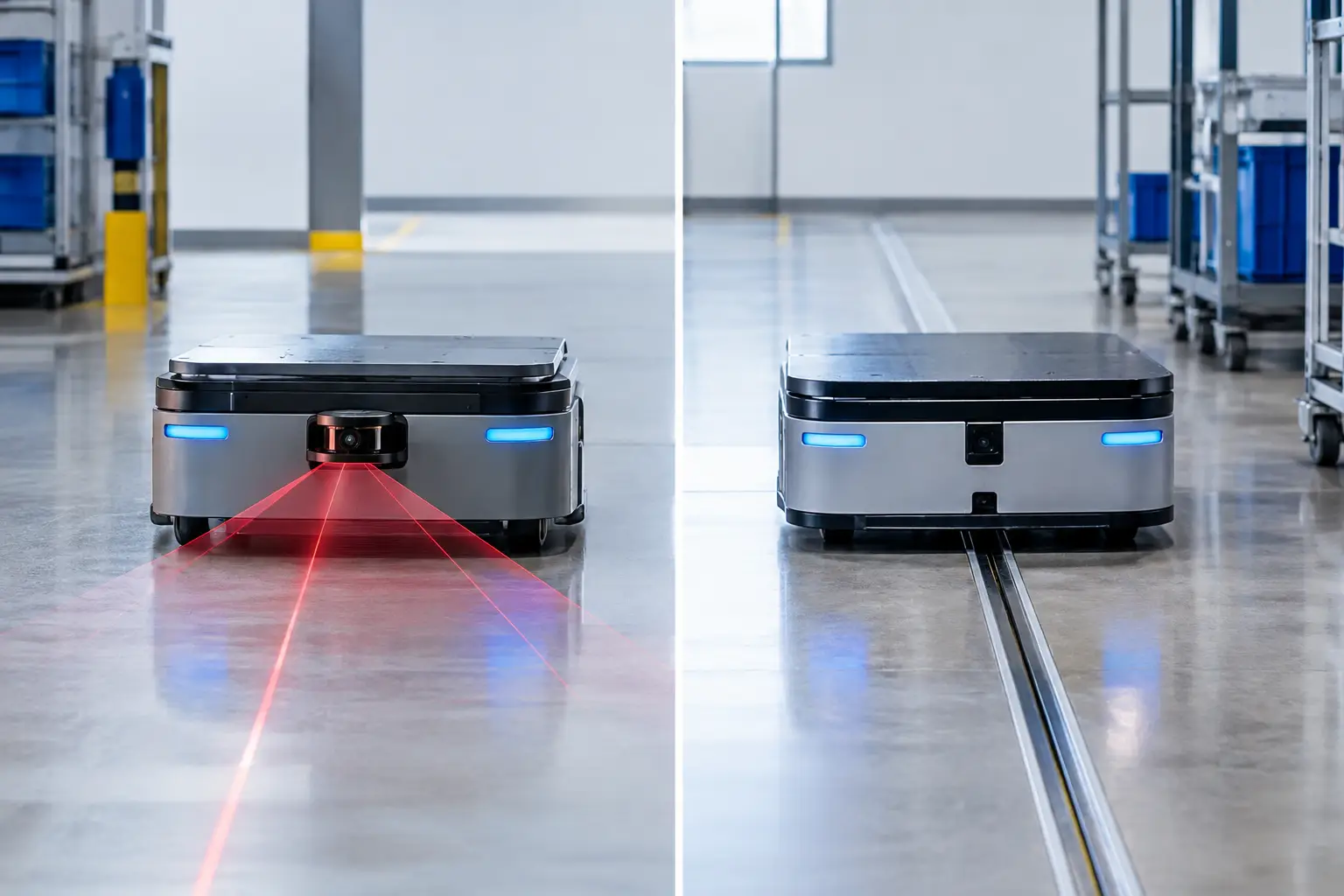
Wire guidance uses an energized wire installed beneath the floor surface, typically along the centerline of each VNA aisle. A sensor on the lift truck detects the signal and steers the truck along the designated travel path. Once engaged, the truck follows a fixed route with consistent lateral control.
Laser guidance uses truck-mounted laser sensors and fixed optical reference points, reflectors, or mapped features to establish the truck’s position and travel path. Exact configurations vary by equipment manufacturer and system design, but the operating principle is the same: the truck receives positional information without relying on an embedded guide wire.
Both approaches are intended to reduce operator steering demands in tight aisles and maintain the clearance required between lift trucks, rack uprights, loads, and protective systems. Neither approach eliminates the need for a properly specified VNA floor.
A guidance system can keep a truck on centerline. It cannot correct floor flatness issues, differential settlement, failed joints, curling slabs, or localized damage in wheel paths. Those conditions still affect mast stability, load handling, tire wear, equipment reliability, and operator confidence.
Laser Guidance vs Wire Guidance: The Core Difference
The central difference is permanence.
Wire guidance creates a physical, fixed path in the slab. This is often an advantage in stable, dedicated VNA operations where aisle locations, rack configuration, and travel patterns are unlikely to change. The system is direct, repeatable, and not dependent on a clear optical line of sight.
Laser guidance generally offers more flexibility when operational layouts may change. Reconfiguring an aisle does not necessarily require cutting and reinstating a guide wire. However, flexibility does not mean fewer requirements. Laser-based systems depend on correctly placed reference points, accurate calibration, clean sensors, protected reflectors where applicable, and an environment that supports consistent detection.
For a fixed, high-throughput warehouse, wire guidance can be the practical choice because it provides a dedicated path with limited variables. For facilities anticipating future rack changes, phased buildouts, or evolving storage strategies, laser guidance may reduce the disruption associated with later layout changes.
The decision is not universal. A system that makes sense for a distribution center with permanent rack geometry may be the wrong fit for a multi-use operation that regularly changes storage density or aisle configuration.
Floor Requirements Still Define VNA Performance
Guidance technology does not reduce the importance of superflat concrete. In many cases, it makes floor quality more visible because guided trucks repeatedly travel in the same wheel paths, under consistent loading, at consistent speeds.
VNA floors should be evaluated for the actual truck, lift height, wheel configuration, load capacity, and operating aisle width. The relevant tolerances are often defined-path requirements, not broad averages taken across a warehouse. A slab can appear acceptable in general use while still creating unacceptable truck movement in a narrow aisle.
Particular attention is required at construction joints, saw cuts, slab transitions, repaired areas, door thresholds, and locations where heavy traffic has caused wear or settlement. Joint deterioration can create impact, vibration, and instability. Localized grinding, joint repair, or a more extensive floor upgrade may be required before a guidance system is commissioned.
For wire guidance, the installation process adds another layer of coordination. The guide path is saw-cut into the slab, the wire is installed, and the cut is sealed or filled according to the system requirements. The work must be planned around reinforcement, embedded services, existing joints, moisture conditions, floor coatings, and the required flatness profile. Poor execution can create unnecessary defects directly within a critical travel path.
Laser guidance avoids saw-cutting for the guide wire itself, but it does not remove the need for floor correction. The truck still runs over the same slab, encounters the same joints, and carries the same loads at height. A poor floor remains a poor floor regardless of how the truck finds its centerline.
Installation Impact and Operational Disruption
Wire guidance installation is usually most efficient in new construction or major warehouse conversion projects, before racking and operations are fully in place. It can also be installed in an active facility, but phasing must be disciplined. Saw-cutting, wire installation, patching, testing, and curing or return-to-service requirements need to be sequenced around operations.
The floor contractor, racking contractor, lift-truck supplier, and general contractor should agree on aisle centerlines and control points before cuts begin. A late change in rack layout can turn a straightforward wire installation into avoidable rework.
Laser guidance may reduce direct floor intervention, which can be valuable in an occupied warehouse where slab cutting is difficult to schedule. It shifts more attention to reference-point installation, line-of-sight verification, calibration, and protection from impacts or changes to the surrounding environment.
In either case, commissioning should include real operating conditions. Testing an unloaded truck at low speed is not enough. The system should be checked with representative loads, operating speeds, lift heights, and aisle traffic conditions. The goal is reliable performance during normal work, not a successful demonstration.
Accuracy, Maintenance, and Failure Risk
Wire guidance is often valued for its consistency. Once installed correctly, the embedded wire provides a known route that is not affected by dust on a sensor window or an obstructed reflector. Its primary risk is physical damage to the wire path from later slab work, anchor drilling, joint repair, or unplanned modifications. Documentation and strict control of future floor penetrations are essential.
Laser guidance avoids buried infrastructure but introduces different maintenance points. Sensors must remain clean and aligned. Reflectors or fixed references must remain in their intended positions. Changes to racks, barriers, building features, or aisle geometry can require recalibration. Facilities should assign clear ownership for inspection and service rather than treating the guidance system as a set-it-and-forget-it asset.
Neither option is inherently maintenance-free. The better question is which maintenance profile fits the operation. A dedicated, stable warehouse may prefer the fixed nature of wire guidance. A facility with frequent physical changes may accept the inspection and calibration discipline of laser guidance in exchange for greater adaptability.
Selecting the Right System for the Facility
Start with the operating plan, not the equipment brochure. If the warehouse will run dedicated VNA aisles for years with fixed rack positions and predictable traffic, wire guidance is a strong candidate. It provides a permanent travel route and can align well with high-throughput, repeatable operations.
If the facility expects rack relocations, changing aisle geometry, phased expansion, or multiple operating modes, laser guidance deserves serious consideration. Its value is strongest where avoiding future slab cutting has operational or financial importance.
Then evaluate the floor honestly. Review as-built drawings, slab joints, repairs, elevation changes, existing coatings, and the condition of the intended wheel paths. Confirm the required flatness and levelness criteria with the truck manufacturer and rack engineer. Do not assume a conventional warehouse slab will meet VNA requirements.
Finally, define responsibility before work starts. The project team should establish who verifies the floor, who sets the aisle centerline, who protects guide paths or optical references, who performs calibration, and who signs off on operational testing. Clear responsibility prevents costly gaps between trades.
Osis Group approaches VNA floor work as an operational surface, not a standalone concrete scope. The objective is a floor system that supports guided traffic, protects equipment performance, and remains serviceable under the demands of daily warehouse use.
The best guidance choice is the one that fits the facility you will operate five years from now, while being installed on a floor capable of carrying that decision every day.