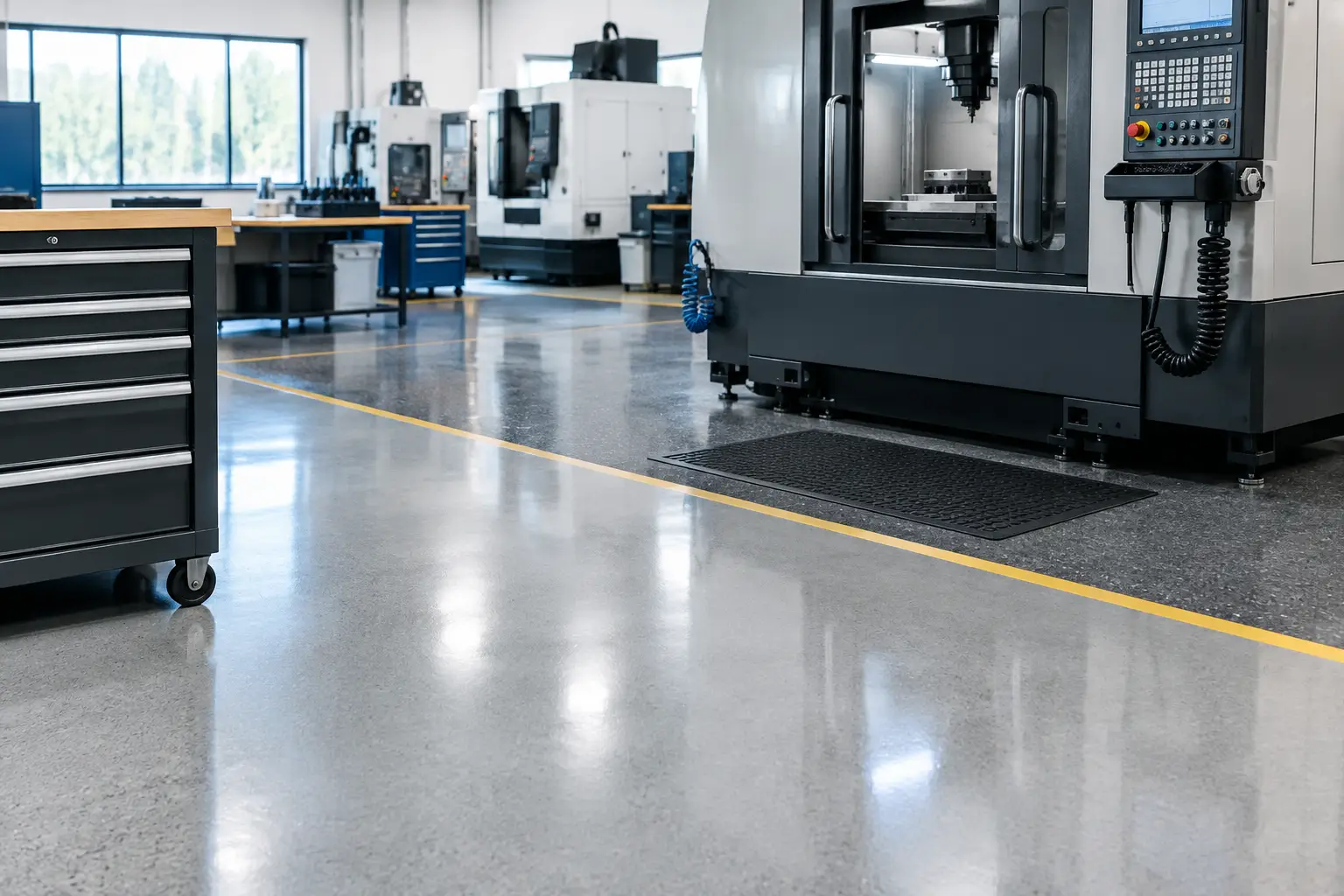
A wire guidance retrofit example is rarely just a matter of cutting a slot in concrete and installing a wire. In a very narrow aisle (VNA) warehouse, the work affects forklift travel, rack clearances, slab condition, production scheduling, and the safety of every operator moving through the aisles.
The right retrofit starts with the operating requirement, then builds the installation plan around the facility's real conditions. That is how a wire guidance system becomes a reliable warehouse control measure rather than another source of downtime and floor repairs.
What a Wire Guidance Retrofit Must Achieve
Wire guidance keeps VNA trucks centered in narrow rack aisles by following an energized wire installed below the floor surface. It allows the truck to travel precisely through an aisle, reducing dependence on manual steering and helping protect racks, loads, and equipment in high-density storage environments.
For an existing facility, the system must do more than guide the truck. The finished floor needs to remain stable under repeated wheel traffic, maintain a flush and durable surface, and avoid creating a weak line through an otherwise serviceable slab. The installation also needs to be coordinated with the truck manufacturer, rack geometry, aisle layout, and the warehouse's available shutdown windows.
A well-executed retrofit therefore has four performance requirements: correct wire location, dependable electrical continuity, durable slot repair, and a floor profile that supports safe VNA truck operation. Missing any one of these can limit the value of the project.
Wire Guidance Retrofit Example in an Active Warehouse
Consider an operating distribution warehouse converting a portion of its storage area to VNA service. The existing slab is in generally good condition, but the facility has conventional forklift traffic, rack aisles that must be reconfigured, and no practical option for a full-building shutdown.
The planned conversion includes twelve narrow aisles. Each aisle requires a centered wire path from the entry point to the far rack end, with defined transitions where trucks enter and exit the guided area. The facility's objective is to increase pallet positions without accepting extended disruption to shipping and receiving.
Before installation, the project team surveys the slab and confirms the intended rack and aisle layout. The wire path is set out from the final rack centerline, not from assumptions based on existing striping or old aisle boundaries. This distinction matters. A wire that is offset by even a small amount can affect truck tracking and operating clearances throughout the aisle.
The floor is then assessed for cracking, joint movement, previous patching, moisture exposure, and areas of localized settlement. Floor flatness and levelness are also evaluated in the VNA travel paths. Wire guidance helps control steering, but it does not correct an unsuitable slab. If the floor profile causes mast sway, wheel unloading, or unstable travel under load, the facility may need floor upgrade and grinding work before or alongside the wire installation.
In this example, several aisle sections show higher spots and worn joint edges. Rather than install the guidance wire over those conditions and leave the risk in place, the contractor grinds the affected travel areas and repairs deteriorated joints before trenching begins. This protects the long-term performance of both the floor and the guided truck operation.
From Layout to Trenching
Once the aisle centerlines are verified, the contractor marks each wire route and identifies all planned crossings, entry transitions, and connection points. The layout must account for slab joints and existing repairs. A joint that moves can damage a wire or fracture the slot filler if it is treated like stable concrete.
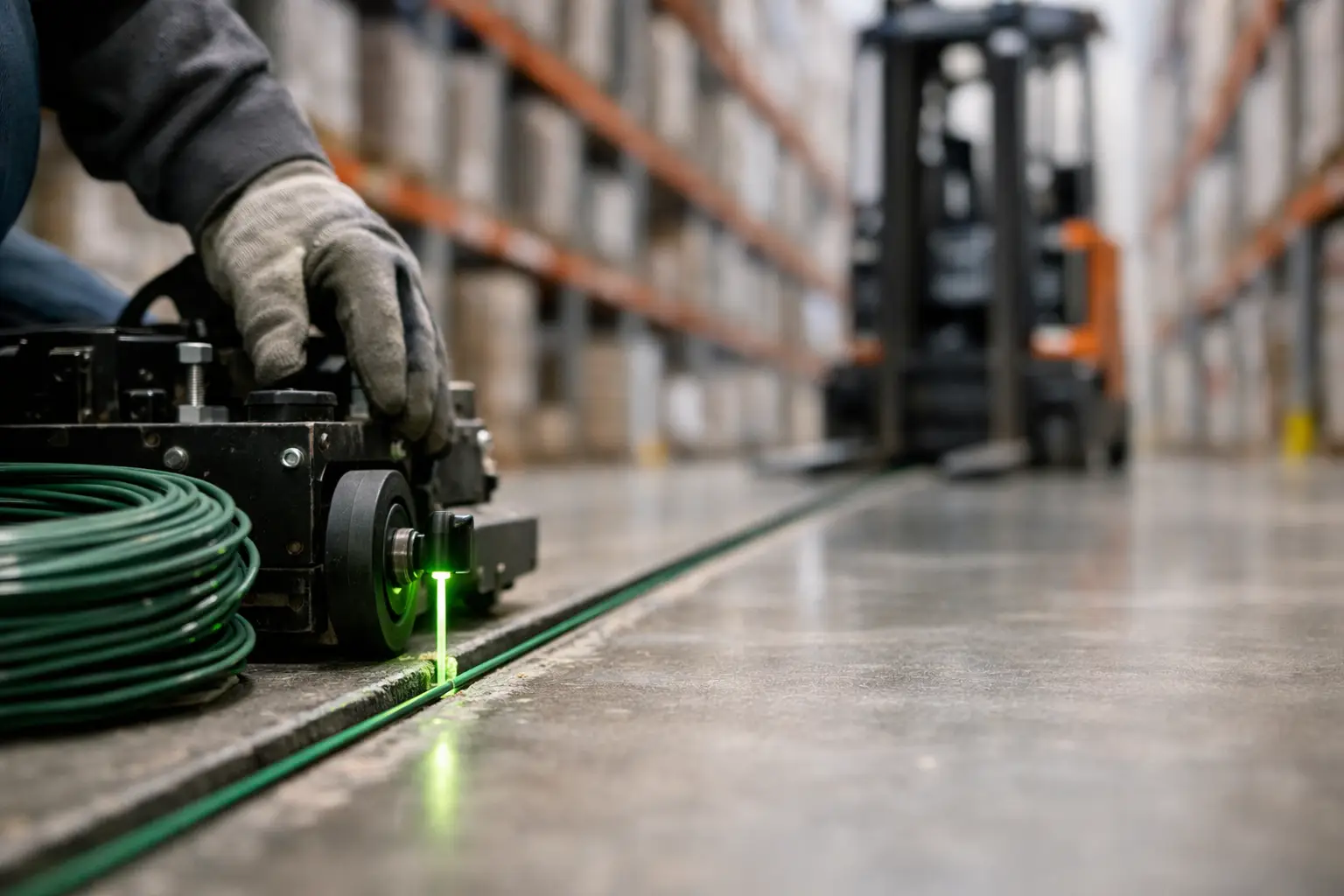
The wire route is cut using controlled saw equipment that produces a narrow, consistent trench. Dust collection is not an optional detail in an active warehouse. Concrete dust can affect inventory, equipment, and adjacent operations, so work areas should be isolated and cleaned before they are returned to service.
The trench depth and width must match the specified wire guidance system. Cutting too shallow can leave insufficient protection at the surface. Cutting excessively wide creates more repair material, more potential for differential wear, and a less controlled finished condition. Precision is the standard.
At joints or areas with known slab movement, the installation approach may need to change. In some cases, the wire route can be designed to avoid a problematic joint. In others, a suitable joint-crossing detail is required to accommodate movement while protecting electrical continuity. The correct answer depends on the joint condition, expected movement, system design, and truck supplier requirements.
After cutting, the trench is thoroughly cleaned. Loose concrete, slurry, and dust compromise adhesion. The guide wire is then installed at the specified depth and secured so it remains in position during encapsulation. Connections are completed according to the system design, with continuity verified before the trench is filled.
The Slot Repair Is Part of the Floor System
A wire trench becomes a permanent part of the traffic surface. The repair material must resist wheel wear, bond to prepared concrete, and cure in a timeframe that supports the facility schedule. A poor fill can chip at the edges, settle below the slab surface, or create a ridge that affects tires and truck stability.
For this reason, the trench is filled with a material selected for the actual environment. High wheel loads, abrasive traffic, temperature changes, washdown exposure, and required return-to-service time all influence the choice. Fast cure is useful when downtime is restricted, but fast cure alone is not a performance specification. The repair must also meet the required strength and wear characteristics.
The filled trench is finished flush with the adjacent floor. Once cured, it is ground where necessary to remove high spots and maintain a smooth wheel path. This final detailing is especially relevant in VNA aisles, where repetitive travel follows the same line every shift.
The same principle applies to entry and exit areas. These zones often see steering inputs, turning forces, and higher localized traffic. They should be inspected closely because their wear pattern may differ from the straight guided aisle.
Testing Before the Aisle Goes Live
Electrical testing should occur during installation and again after the floor repair is complete. The contractor confirms continuity and verifies that the installed wire responds correctly with the specified VNA equipment. The truck supplier or qualified commissioning team then calibrates the vehicle's guidance system and completes functional travel tests.
Testing should include full-length travel, entry and exit behavior, alignment under normal operating loads, and performance at expected travel speeds. If the building uses multiple truck models, compatibility needs to be confirmed for each approved unit. A successful test with one truck does not automatically validate every vehicle in the fleet.
The floor should also receive a visual and operational inspection. The finished trench should be flush, free of cracking or debonding, and cleanly transitioned at joints and aisle entrances. Any deficiencies are easier and less costly to correct before racking is fully loaded and the area becomes part of daily production.
Planning the Retrofit Around Uptime
In active facilities, sequencing is often the deciding factor in project success. A practical approach is to complete the work aisle by aisle or in defined work zones, releasing each area only after the trench repair has cured, been inspected, and passed testing. This requires close coordination among the flooring contractor, racking contractor, electrical team, truck provider, and warehouse operations.
The schedule should account for more than installation labor. It must include access restrictions, inventory relocation, dust control, cure time, equipment testing, and contingency for hidden slab conditions. Existing floor repairs, moisture-related damage, or unmarked embedded elements can change the scope once work begins.
Clear communication protects the opening date. Operations personnel need to know which aisles are unavailable, when equipment can return, and what traffic routes remain open. Contractors need confirmed access and a defined decision process if site conditions differ from the survey.
When a Retrofit Needs More Than Wire Guidance
A wire guidance system improves truck control, but it cannot compensate for broader floor deficiencies. If the warehouse is moving to higher racks, heavier loads, or narrower aisles, the slab must be evaluated as a complete operating surface.
Cracked joints, widespread spalling, poor floor flatness, and unstable patches should be addressed before they affect VNA performance. Depending on the findings, the right scope may include joint repair, precision grinding, localized slab repair, or a larger floor upgrade program. For new construction or major expansions, a Superflat VNA floor may be the better long-term solution.
Osis Group approaches wire guidance work as an industrial flooring project with operational consequences. Accurate layout, controlled preparation, durable repair details, and disciplined commissioning protect the value of the warehouse conversion.
Before approving a retrofit, walk the proposed aisles with the final rack plan, the truck specification, and the floor assessment in hand. That early coordination is where a dependable VNA operation begins.